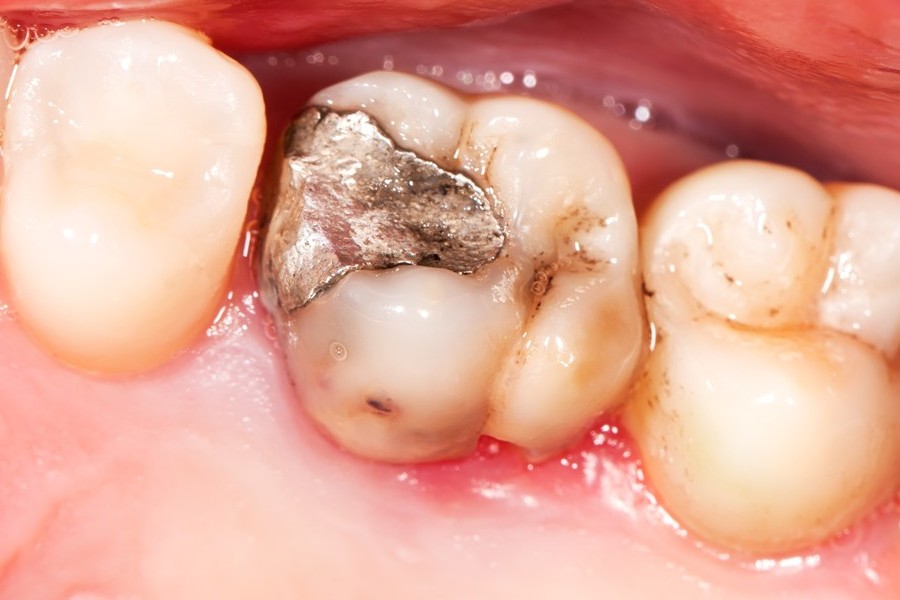
Here's a fact that surprises most people: the "silver" fillings that have been placed in hundreds of millions of mouths are roughly half mercury, by weight. Not a trace. Half. For most of the last century, that was considered completely normal, and then, slowly, the ground started to shift.
In 2025, the U.S. Indian Health Service announced it will phase out mercury-containing dental fillings by 2027. Globally, amalgam use has been declining for years under an international treaty called the Minamata Convention. And back in 2020, the FDA issued guidance recommending that certain higher-risk groups consider mercury-free alternatives. None of this happened because of a single dramatic study. It happened the way these things usually do, gradually, then all at once.
So patients are understandably asking me: should I be worried about the fillings already in my mouth? It's a fair question, and it deserves a real answer rather than a scary one.
Let's start with what's actually true
Mercury is a neurotoxin. That's not a holistic talking point. It's basic toxicology, and nobody disputes it. Dental amalgam is about 50% mercury, and amalgam fillings can release small amounts of mercury vapor, particularly with chewing, grinding, or hot liquids, and especially as fillings age.
And here's the other half of the truth, the part that gets left out when this topic goes viral: for most people with stable, intact fillings, that vapor exposure is low, and the FDA still considers amalgam an acceptable material for the general population. Both of those statements are true at the same time. Holding both is the whole job.
Who the caution is really for
When the FDA updated its guidance, it didn't tell everyone to panic. It identified groups who may be more vulnerable to the effects of mercury exposure and recommended they consider non-mercury options when possible. That list generally includes:
- People who are pregnant or planning to become pregnant, and those who are nursing
- Infants and children
- People with pre-existing neurological conditions or impaired kidney function
- People with a known sensitivity or allergy to mercury or other amalgam components
This is what individualized care looks like in practice. "Safe for the average person" and "the best choice for this person" are not always the same sentence, and the gap between them is exactly where thoughtful dentistry lives.
The part most people get backwards
If there's one thing I want you to take from this article, it's this: how you remove a mercury filling matters more than whether you remove it.
Here's why. Drilling out an old amalgam filling is, briefly, the single biggest mercury-vapor event that filling will ever produce. Done carelessly, no isolation, no special suction, removal can expose you to more mercury than simply leaving the filling alone would have. This is the irony that surprises people: unsafe removal can be worse than no removal.
That's why biological dentists use a defined safety protocol. The International Academy of Oral Medicine and Toxicology developed the SMART protocol — Safe Mercury Amalgam Removal Technique. It layers protections: a rubber dam to isolate the tooth, high-volume suction designed to capture vapor, copious water to keep the filling cool, supplemental clean air for you to breathe, and protection for the dental team too. The goal is simple, if mercury is going to be disturbed, contain it.
The takeaway, plainly
The FDA does not recommend removing intact amalgam fillings in good condition unless it's medically necessary, because removal itself carries exposure. But if you do choose removal, for your own reasons, or because a filling is failing. It should always be done with a mercury-safe protocol. Never let anyone drill amalgam out of your mouth without protection.
How I talk about this with patients
I won't tell you your fillings are poisoning you. That's not honest, it's not something I can know about you as an individual, and fear isn't a foundation for a good health decision. What I will tell you is that mercury is a real neurotoxin, that exposure and susceptibility vary from person to person, and that you have every right to make a conscious, informed choice about what sits in your mouth every day for decades.
For some patients, that means safely replacing old amalgams with biocompatible, tooth-colored materials. For others, low-risk, stable fillings, no symptoms. It means doing nothing for now, with eyes open. Both can be the right call. What matters is that it's your call, made with the full picture.
If something is slowly working against your body, it's worth at least understanding. Not because you should be afraid, but because awareness is how good decisions start. Always learning. Always questioning. Always exploring.