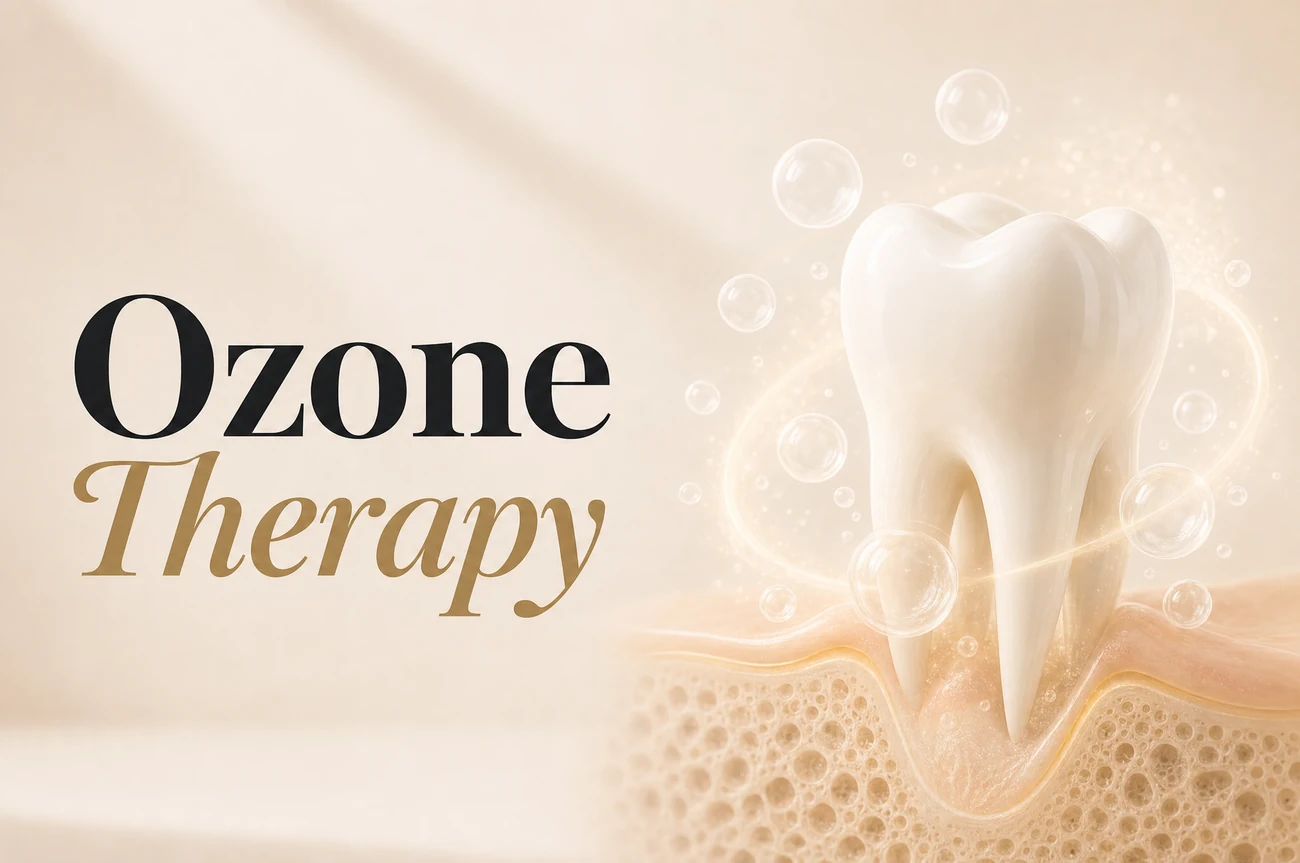
Ozone is one of those things patients either have never heard of or have heard far too much about. Somewhere between "what is that" and "I read it cures cavities" sits the actual answer, and I would rather give you that than a sales pitch.
So here is how I think about ozone after using it for years, including the parts that are less flattering than the marketing you may have read.
What ozone actually is
Ozone is oxygen with a third atom attached. That third atom is loosely held, which makes the molecule unstable and highly reactive, and that reactivity is the entire point. When ozone contacts a bacterial cell wall, it disrupts it. Then the molecule breaks back down into ordinary oxygen, leaving nothing behind.
In the office it comes in three forms: ozone gas, ozonated water, and ozonated oils. I use different ones for different jobs, and none of them involve you breathing it, which is the question everyone actually wants to ask.
Where the evidence is genuinely strong
Ozone is a well-documented antimicrobial. In laboratory conditions it reliably kills the bacteria, viruses and fungi we care about in dentistry, and it does so without the resistance problems that come with antibiotics. That part is not controversial.
That is why I reach for it in specific situations: disinfecting a cavity preparation before I place a restoration, treating a periodontal pocket, rinsing an extraction site, and as part of the cleanup during safe mercury removal. In each of those the goal is straightforward. Fewer bacteria in a space I am about to close up or heal.
Where the evidence is thinner than you have been told
Here is the part most ozone pages leave out. The strongest reviews we have do not support the claim that ozone gas alone stops or reverses tooth decay. A Cochrane systematic review looking at exactly that question found no reliable evidence for it, with inconsistent results across studies and a high risk of bias in the trials available.
Newer reviews are somewhat more encouraging, particularly for early lesions in baby teeth, but underneath they say the same thing: the studies are small, the methods vary, and we need larger and longer trials before anyone should be promising cavity reversal.
So if a practice tells you ozone will make a cavity disappear, be skeptical. I cannot tell you that, because the evidence does not let me.
How I actually use it
I treat ozone as an adjunct. It is something I add to good dentistry, never something I substitute for it. If a tooth has lost structure, it needs a restoration, and no amount of ozone changes that. If an infection is established, it needs to be addressed properly.
Where ozone earns its place is in the margins: a cleaner field before I restore, a gentler option for an anxious patient, and a way to reduce bacterial load without reaching for something harsher. Those are modest benefits. They are also real ones, and modest and real is a combination I will take.
The honest summary
Ozone is a useful tool with a good safety record when handled correctly, and it fits naturally into how we practice here. It is not magic, it is not a replacement for treatment, and the research on its most-hyped application is not where its advocates suggest.
If that sounds less exciting than what you have read elsewhere, good. I would rather you trust what I tell you about the things that do work. You can read more about how we use it on our ozone therapy page, or ask me about it at your next visit.